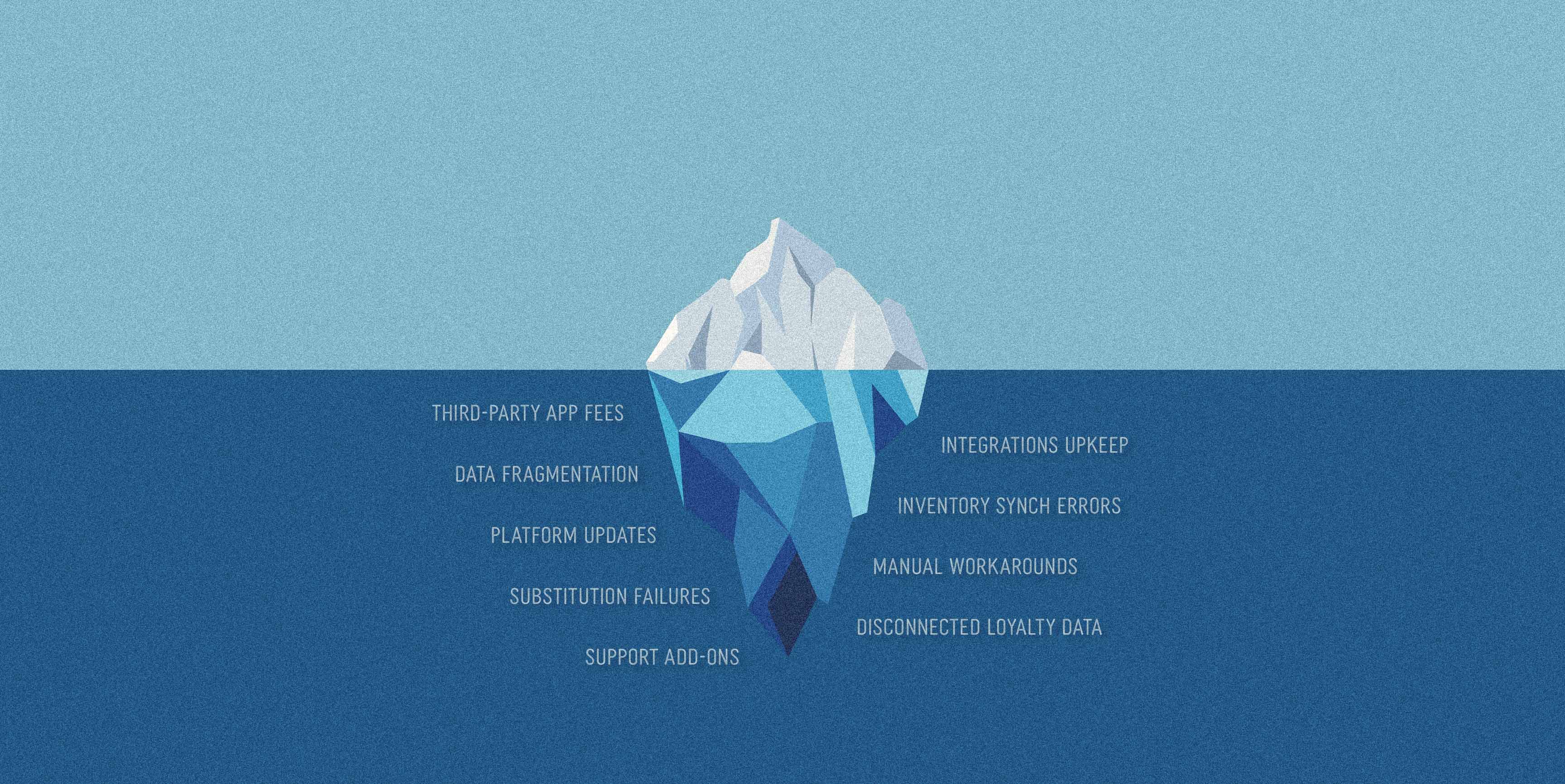
A DIY ecommerce site can look like the economical choice.
The platform fee is low. The theme is affordable. A few apps promise to add whatever the core product is missing. For a standard online store, that approach may be enough to launch quickly.
Grocery ecommerce is different.
The moment a retailer adds live store inventory, weighted products, substitutions, delivery and pickup slots, in-store picking, loyalty, multi-location pricing, and last-mile delivery, the “simple” website becomes a connected operating system. Every missing capability needs an app, a custom integration, a manual workaround, or all three.
That is when the low starting price stops reflecting the real cost.
The right comparison is not monthly platform fee versus monthly platform fee. It is the total cost of ownership of operating, maintaining, and scaling the entire ecommerce stack.
What does “DIY ecommerce” really mean?
A DIY ecommerce site does not always mean coding a storefront from scratch. It usually means assembling an online business from separate components:
- a general-purpose ecommerce platform or open-source CMS
- a paid theme or custom front end
- apps for local delivery, search, loyalty, subscriptions, reviews, and promotions
- plugins for SEO, analytics, consent, accessibility, and security
- connectors to POS, ERP, CRM, payment, inventory, and delivery systems
- custom code for workflows the apps cannot support
Each tool may solve one problem. The risk appears when those tools have to behave like one reliable grocery operation.
A shopper sees a single website. Behind it, the retailer may be managing ten or more vendors, separate contracts, different support teams, overlapping data, and multiple points of failure.
Why grocery exposes the limits of generic ecommerce
Most ecommerce platforms were designed around predictable products: a shopper orders one item, the seller ships that exact item, and inventory changes at a manageable pace.
Grocery is far less forgiving.
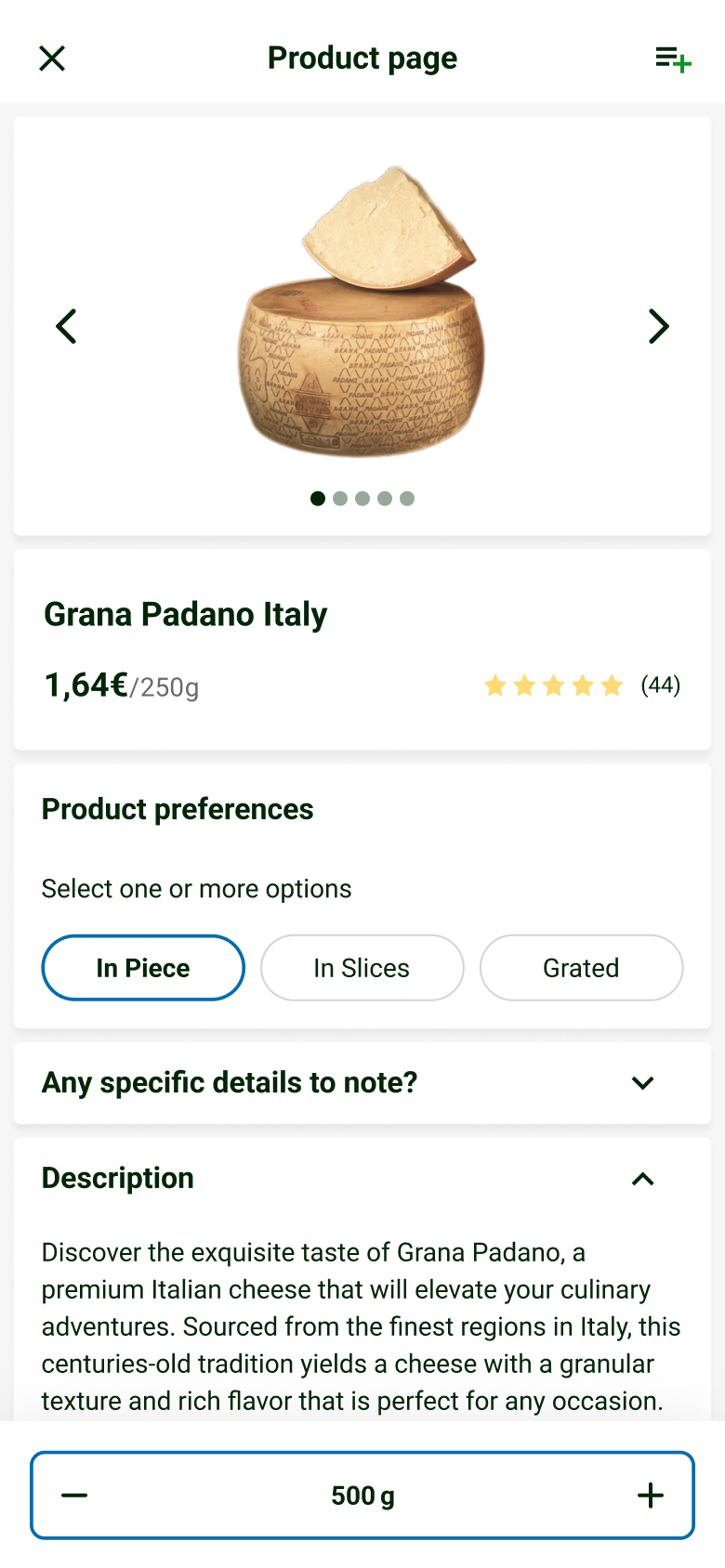
A product may be sold by weight. The final price may change after picking. A fresh item may need a preference such as “ripe today” or “thinly sliced.” Stock moves continuously across physical stores. A replacement may need the shopper’s approval. Delivery capacity depends on staff, vehicles, geography, and time of day.
For a grocery retailer, these are not edge cases. They are the everyday operation.
A generic ecommerce platform can often be adapted to support them, but adaptation comes with a cost. The more the business grows, the more exceptions the stack must handle, and the more fragile the connections can become.
The five grocery-specific hidden costs of a DIY ecommerce site
Generic ecommerce costs still matter, but grocery adds operational requirements that most site builders were not designed to manage. These costs appear when the storefront must stay aligned with fast-moving store inventory, variable product weights, substitutions, picking capacity, and delivery promises.
1. Weighted products and substitutions create exception costs
A standard ecommerce order is usually charged at checkout and shipped as placed. Grocery orders can change after checkout.
A shopper may order one kilogram of bananas and receive a different final weight. An unavailable item may require a replacement, shopper approval, a price adjustment, or a refund. Fresh products can also carry preferences such as ripeness, cut, or pack size.
If the core platform cannot support these workflows, the retailer pays for custom logic and additional apps. Store teams may also need to contact shoppers or correct orders manually. Those exceptions increase picking time, customer-service work, payment adjustments, and refund risk on every affected basket.
2. Store-level inventory and pricing need continuous synchronization
Grocery stock changes minute by minute as customers shop in-store and online. Prices, promotions, and availability may also differ by location.
A DIY stack must connect the storefront with the retailer’s POS, ERP, inventory, promotion, and loyalty systems. It also needs rules for sync frequency, out-of-stock thresholds, product mapping, and failures. This is not a one-time integration project.
When the connections drift, shoppers can order products that are no longer available or see the wrong store price. The retailer absorbs the cost through substitutions, refunds, support requests, and lower trust. Monitoring and maintaining these store-level data flows becomes a grocery-specific operating expense.
3. Digital orders add picking and capacity costs inside the store
Online grocery does not end at checkout. Each order must be picked from shelves, checked, packed, staged, and handed to the shopper or driver within a promised window.
A generic storefront may accept orders without understanding picker availability, store workload, cold-storage limits, delivery capacity, or pickup congestion. Retailers then need separate picking and scheduling tools, custom integrations, or manual controls to avoid taking more orders than a store can fulfill.
Poor coordination creates overtime, late orders, missed items, and cancelled slots. The cost belongs in the ecommerce calculation because the platform determines how accurately demand is matched with store capacity.
4. Grocery catalog complexity increases data and merchandising work
Grocery catalogs can contain tens of thousands of SKUs, frequent assortment changes, variable-weight products, nutritional information, allergens, pack sizes, deposit fees, and location-specific availability.
Generic ecommerce tools often require extra apps or custom data models to manage that information. Merchandising teams may duplicate updates across systems or correct incomplete product records by hand.
The larger the catalog and store network, the more this work compounds. A small mapping issue can affect thousands of products, while a slow or overloaded catalog can make weekly-basket shopping harder on mobile.
5. Multi-store fulfillment makes every change more expensive
Adding a store is not simply adding another location page. The retailer may need new inventory feeds, pricing rules, tax settings, delivery zones, pickup capacity, operating hours, and fulfillment users.
In a fragmented stack, each launch can involve several vendors and repeated configuration. A change to a promotion, substitution rule, or delivery partner may need to be tested across every store and integration.
This raises the cost of expansion and slows commercial decisions. A platform that works for one pilot store can become expensive when the business needs consistent operations across ten or fifty locations.
The grocery ecommerce cost formula
For grocery retailers, a useful total-cost calculation must include the operational work created between checkout and fulfillment:
This includes maintaining store-level inventory and pricing, processing weighted products and substitutions, managing picking and delivery capacity, and absorbing refunds or errors when fulfillment breaks down.
DIY stack vs. purpose-built grocery ecommerce platform
A purpose-built platform is not automatically the right answer for every retailer. The decision depends on business maturity, requirements, resources, and growth plans.
The point is to compare complete operating models, not a low entry price with a comprehensive platform fee.
When does a DIY ecommerce site make sense?
A DIY approach can be reasonable when:
- the retailer is testing demand with a small catalog
- order volume is low
- there is only one location
- fulfillment is simple
- grocery-specific workflows are limited
- the business has technical resources ready to own the stack
- speed of experimentation matters more than long-term efficiency
It can also make sense when the ecommerce channel is intentionally temporary or narrow.
But the retailer should decide in advance what success looks like. If the pilot works, can the stack support ten times the orders, more stores, more complex inventory, and higher customer expectations? If not, migration needs to be part of the original plan.
Signs the app stack has become a trap
It may be time to reconsider the architecture when:
- app and maintenance costs keep rising without a clear return
- one update regularly breaks another part of the store
- teams rely on spreadsheets or manual re-entry
- inventory, pricing, or order data frequently falls out of sync
- staff do not know which vendor owns an issue
- launching a store or feature takes months
- the mobile experience is slow or inconsistent
- reporting requires extensive reconciliation
- grocery-specific needs still depend on workarounds
These are not isolated inconveniences. Together, they indicate that the business has outgrown the platform model.
What to look for in a grocery ecommerce platform
A retailer evaluating grocery ecommerce software should test the platform against real operating scenarios, not only a polished storefront demo.
Ask whether it supports:
- Grocery product logic: weighted items, fresh-product preferences, substitutions, large catalogs, and store-level availability.
- Inventory and pricing: reliable synchronization with existing systems across one or multiple locations.
- Fulfillment: efficient order picking, customer communication, order changes, and exception handling.
- Delivery and pickup: dynamic timeslots, capacity rules, zones, fees, driver workflows, and third-party delivery options.
- Retention: loyalty, promotions, personalization, repeat ordering, and branded mobile experiences.
- Integrations: documented ways to connect the retailer’s ERP, POS, CRM, payments, and delivery tools.
- Operational control: an admin experience that business teams can use without constant developer support.
- Scalability and support: a clear plan for growth, reliability, onboarding, updates, and issue ownership.
Build what differentiates your grocery business, not the plumbing
Retailers should control what makes their business distinctive: brand, assortment, pricing strategy, service model, customer relationships, and operational know-how.
They do not necessarily need to build and maintain every technical layer behind those advantages.
The most sustainable approach is often to buy the capabilities that are common but complex, including commerce infrastructure, security, core grocery workflows, and platform maintenance. Retailers can then invest internal resources in the experiences that create genuine differentiation.
That reduces the amount of engineering spent recreating the basics and gives product, marketing, and operations teams more room to improve the business.
How Wave Grocery replaces the patchwork
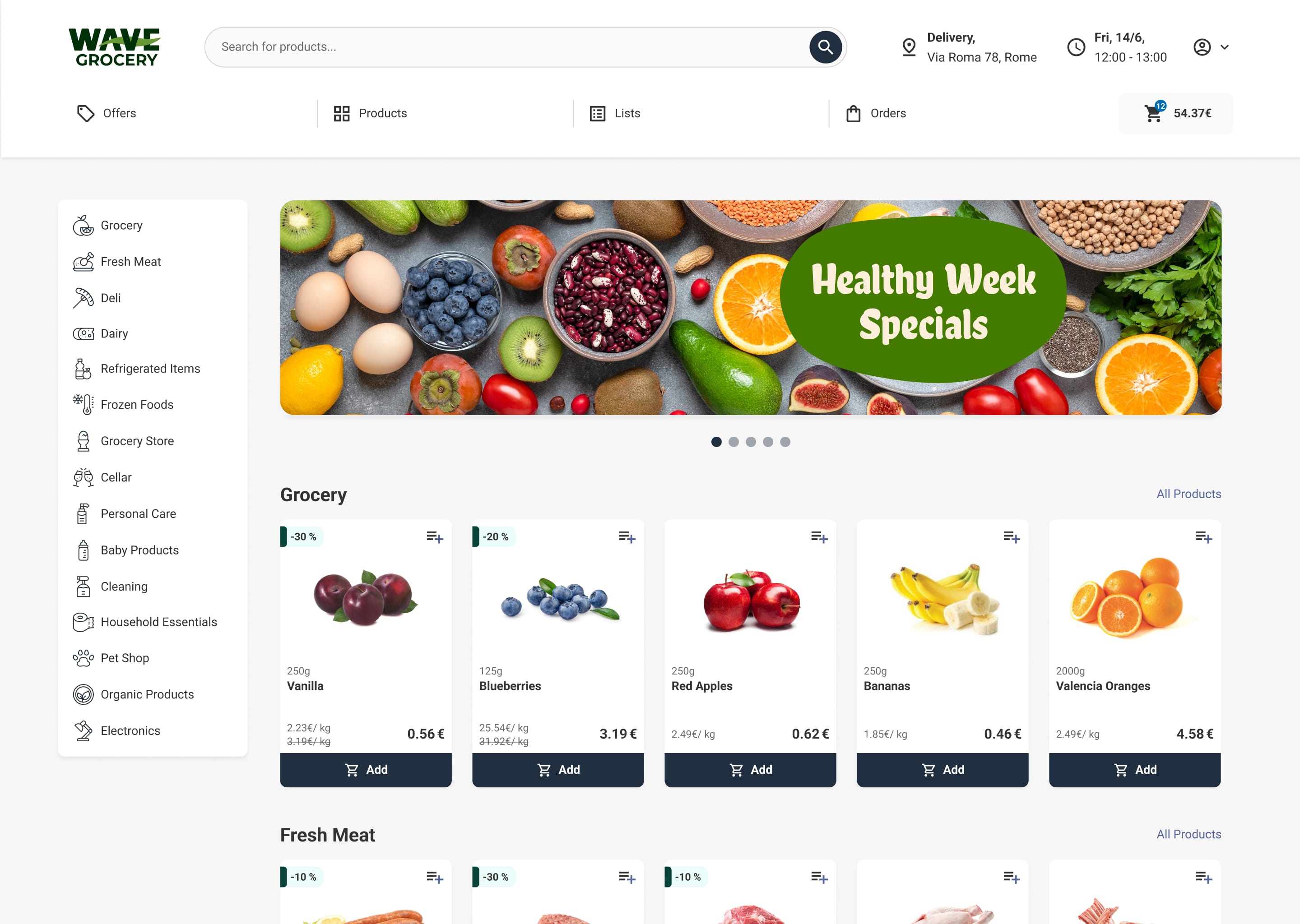
Wave Grocery is a purpose-built, white-label grocery ecommerce platform. It brings the shopper-facing and operational parts of online grocery into one environment, including:
- a branded grocery ecommerce website
- native mobile apps
- centralized catalog, promotion, slot, and order management
- weighted-product and substitution workflows
- in-store picking tools
- delivery and pickup management
- loyalty and personalization capabilities
- integrations with the retailer’s existing business systems
Instead of adapting a generic storefront to behave like a grocery operation, retailers start with grocery logic as part of the core platform.
That does not eliminate the need for integrations or implementation. It changes who owns the complexity. The platform and its team are responsible for keeping the core product coherent, while the retailer focuses on assortment, customers, operations, and growth.
Wave Grocery also uses a pay-as-you-grow pricing model, helping retailers evaluate costs against the development, app, maintenance, and support burden of a fragmented alternative.
Final takeaway
A low monthly fee can be attractive, but it is not a strategy.
For grocery retailers, the true cost of ecommerce sits across the whole operation: apps, integrations, maintenance, staff time, performance, data, fulfillment, and the ability to change quickly.
A DIY site may help a business start. A patchwork of third-party tools may fill the first few gaps. But once ecommerce becomes an important sales channel, the architecture needs to support the realities of grocery instead of forcing the operation to work around the software.
Before choosing or renewing a platform, calculate the full three-year cost. Test real grocery scenarios. Identify every dependency. Put a value on internal time and delayed growth.
Then choose the model that will still work when online grocery is no longer an experiment.
%2520copy.jpeg)
Tasos Koskolos is Head of Product, applying an engineering mindset to e-grocery tools that boost throughput, accuracy, and customer loyalty.

Our editorial team works hand-in-hand with grocery experts and digital specialists to deliver actionable content designed to help your business thrive online. Each article is built on real industry insights and practical guidance for grocers, providing actual solutions to real problems.