The Challenge: Why Grocery Retailers Need Their Own Mobile App
Over 50% of online grocery shopping now happens on mobile devices. Yet most grocery retailers face two related questions. First: do they own their digital channel, both a web storefront and a dedicated mobile app, or do they default to a third-party marketplace like Instacart, Uber Eats, Deliveroo, or efood (Greece's leading delivery app)? Second: if they do build their own channel, is a mobile-responsive website enough, or does grocery, with its 50+ item baskets and weekly habits, demand a dedicated native mobile app?
The marketplace route feels easy, until you realize you don't own the customer relationship, the data, or the experience. You're a tenant on someone else's platform, competing for attention alongside every other grocer in the catalog. And the responsive-web-only route, keeping a desktop-first storefront and hoping it works on a phone, fails the moment a customer tries to manage a 55-item weekly basket on a 6-inch screen.
Meanwhile, retailers who hesitate lose ground every quarter. Without a dedicated mobile channel, they face checkout failures, cart abandonment from overly long flows, broken loyalty integrations, and unstable performance during peak hours. These aren't just UX annoyances; they destroy conversion. And in grocery, where each session involves 50+ items and represents a high-value stock-up order, a single bad experience can lose a customer for an entire month.
This was the reality facing several enterprise grocery retailers across Europe and the Middle East. They needed a mobile app that was truly theirs: fast, stable, personalized, and capable of converting visitors into loyal repeat buyers.
The Landscape: A Gap in the Market
We launched our first enterprise partner's grocery mobile app in 2018. Back then, the competitive landscape was remarkably thin:
- In Greece, only one major chain had a functioning mobile ordering app, and it barely worked. Most competitors had no mobile presence at all.
- In Europe and the US, even large chains were either relying on marketplace integrations or had no dedicated mobile app. The exceptions (like Walmart) were few and far between.
- Aggregator and delivery apps, from global players like Instacart, DoorDash, Uber Eats, and Deliveroo, to regional leaders like efood (Greece's dominant delivery platform), Wolt, and BOX (our own grocery-focused delivery app), were growing rapidly and training consumers to expect mobile-first ordering, but as marketplace tenants, not as brand-owned experiences.
For forward-thinking retailers, this was a clear opportunity: launch a best-in-class mobile app before the competition, own the channel, and be ready for whatever came next.
As it turned out, what came next was a global pandemic, and the retailers who had already invested in mobile were the ones prepared to handle the surge.
Our Answer: Wave Grocery, a Mobile-First Grocery Commerce Platform
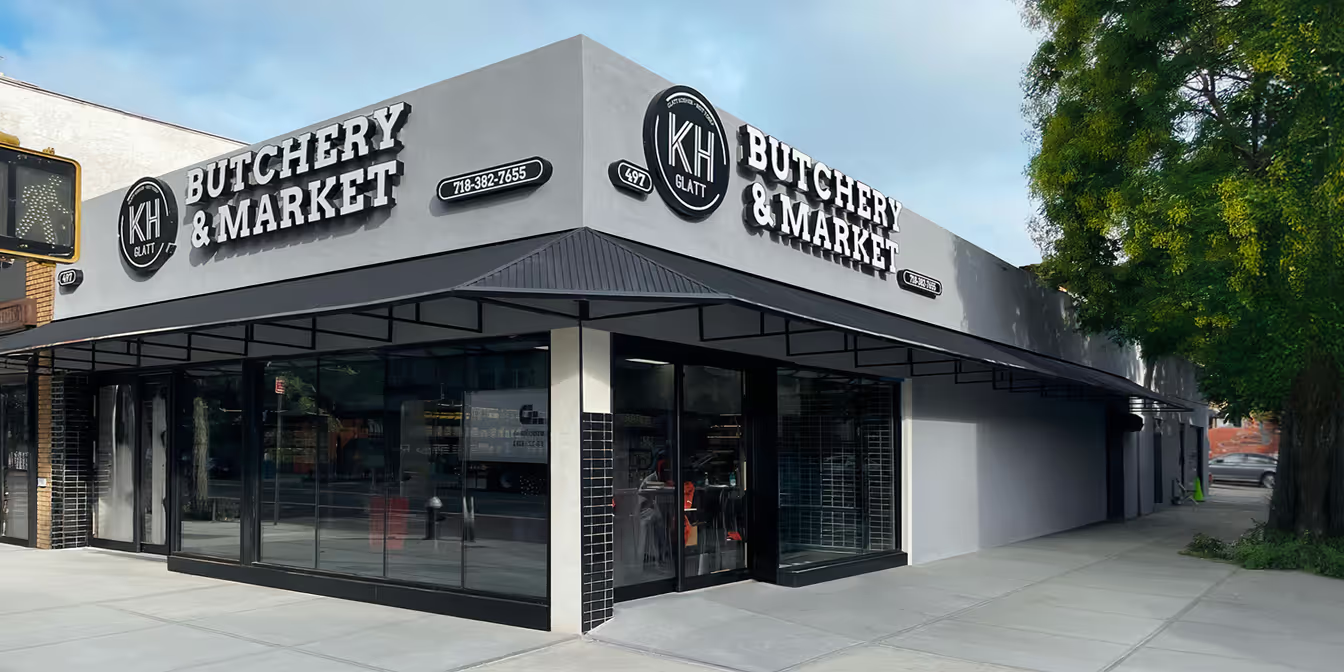
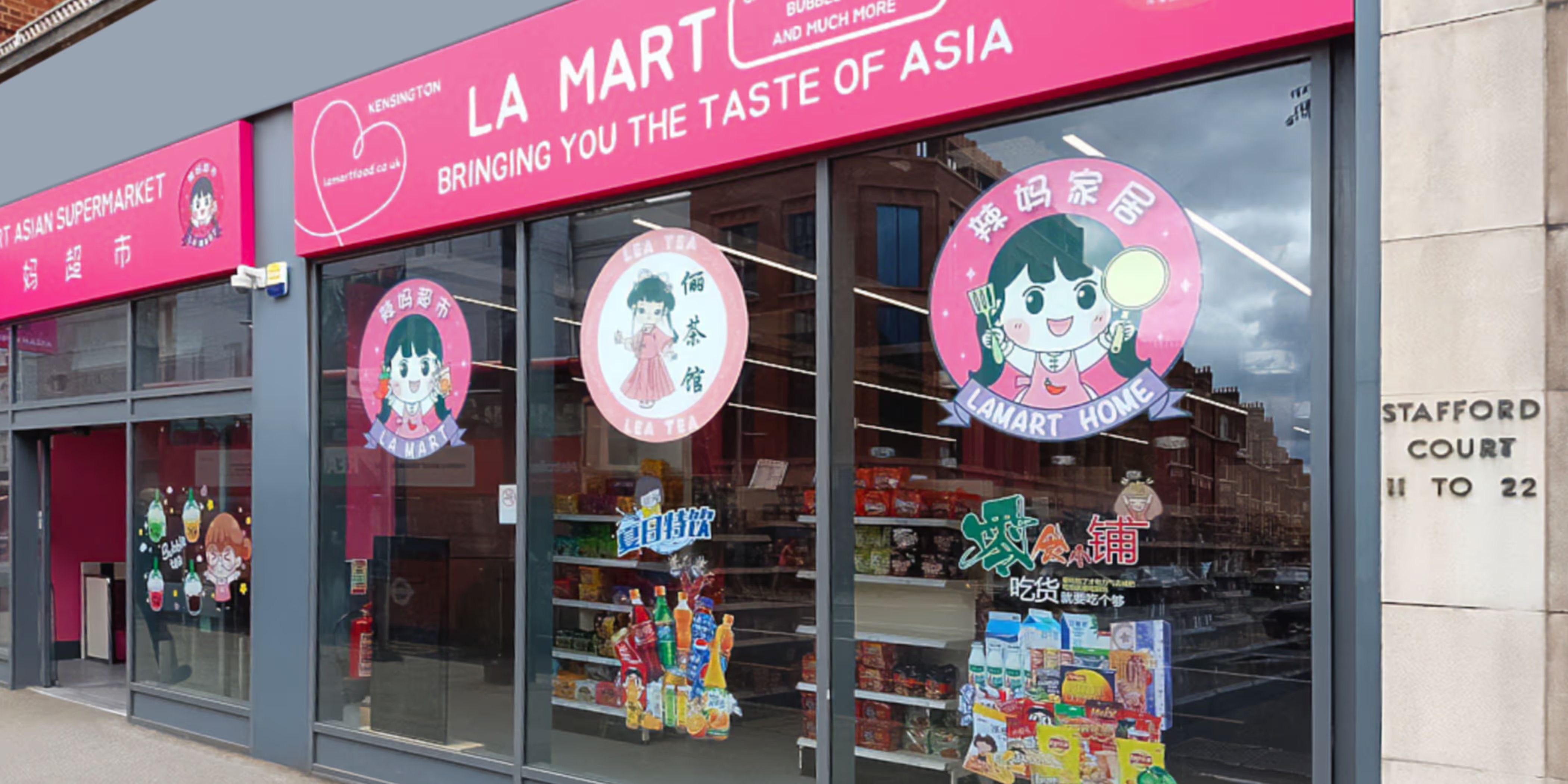
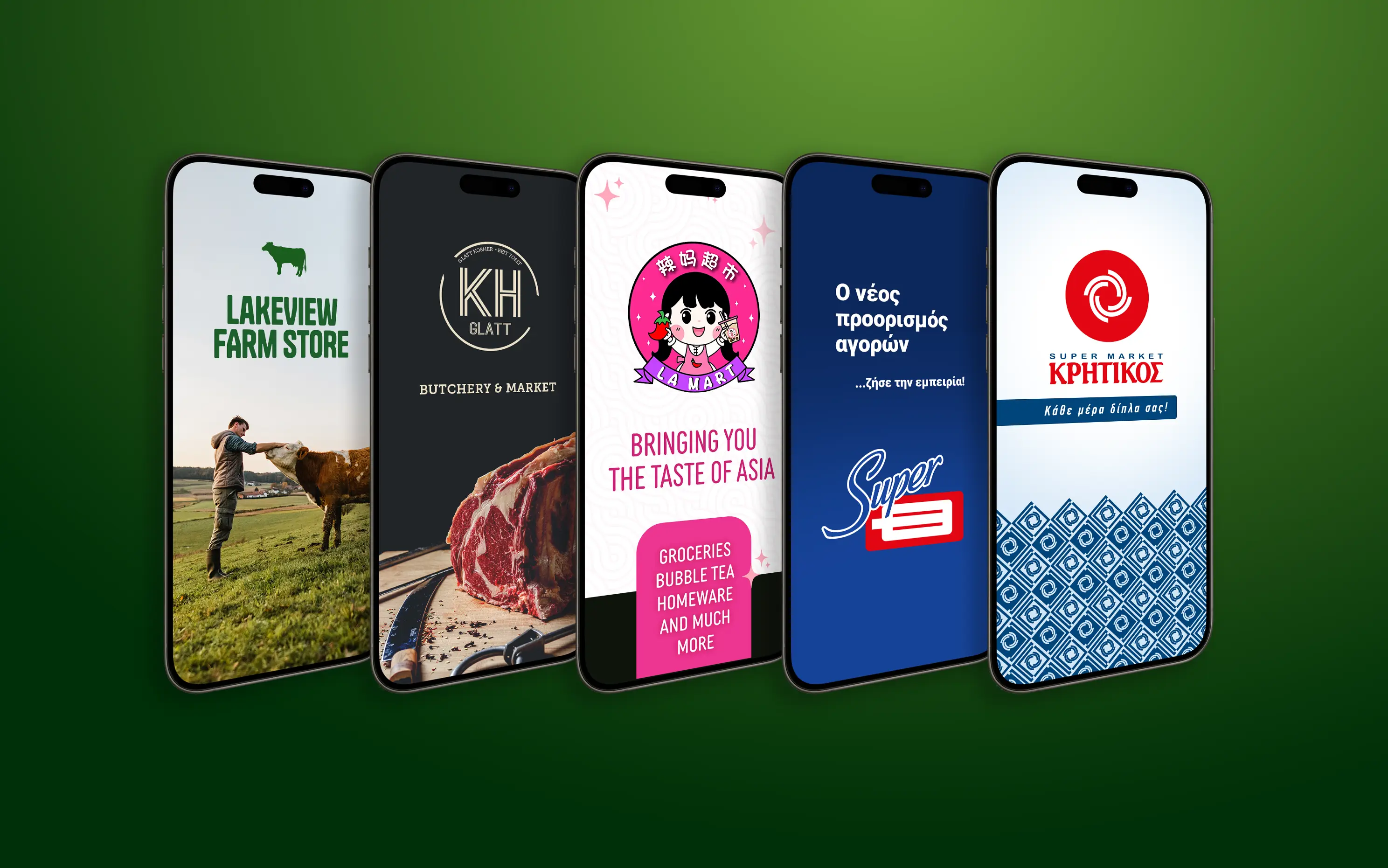
We built Wave Grocery as our full-stack grocery e-commerce platform: native mobile apps, web storefronts, loyalty engine, and operational tooling, all purpose-built for grocery retail. Today, Wave Grocery powers enterprise grocery retailers, including Kritikos (400+ stores across Greece), Thanopoulos, Realfoods and La Mart, each running their own branded app on our platform.
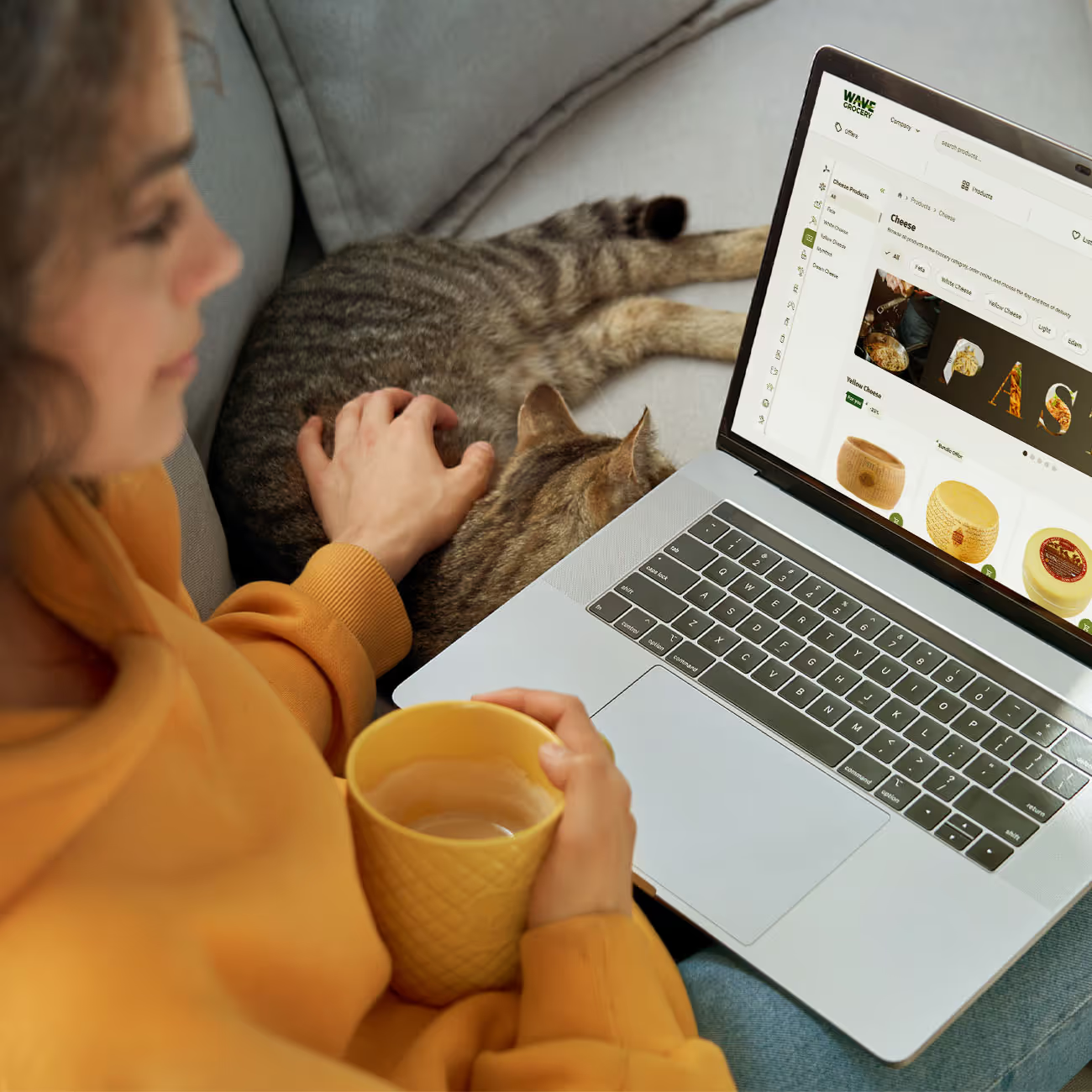
Crucially, Wave Grocery is built as a unified channel-agnostic platform: web storefront and native mobile app share the same catalog, pricing, loyalty, and order flow, so retailers own the entire customer journey instead of choosing between a marketplace tenancy and a mobile-responsive website that breaks under a 55-item basket.
Rather than building a custom app from scratch for each retailer, we engineered Wave Grocery as a partner-ready platform: one shared codebase that powers multiple partners, each with their own requirements, branding, and configuration, without rebuilding from zero every time.
What makes Wave Grocery different isn't any single feature. It's how product thinking, design, and engineering come together around one reality: grocery is fundamentally different from generic e-commerce.
We tell that story through the three perspectives that shaped the platform.
Product: Understanding What Grocery Actually Needs
"When we launched the first mobile app, only one competitor in Greece had anything close, and it barely worked. We weren't just building an app; we were giving our partners a direct channel to their customers before anyone else in the market had one. When COVID hit, the retailers who had already invested in mobile were the only ones ready. That's when the real value of being early became obvious."

Most e-commerce platforms optimize for baskets of 1–5 items. Grocery is fundamentally different. The average Wave Grocery order contains ~55 products. That changes everything about how you build, and it demands a product vision that prioritizes speed-to-basket and list management over casual browsing.
From the start, we built around the problems that generic platforms ignore:
- The "counter" experience. Granular customization for fresh deli and cheese products. A customer can order the same item in multiple ways within one basket (e.g., 15 slices of Gouda for sandwiches and 300g of grated cheese for cooking). This extends to custom deli platters, mixed boxes, and weighted items (e.g. comment for “crisp apples” or “my bananas to be ripe”).
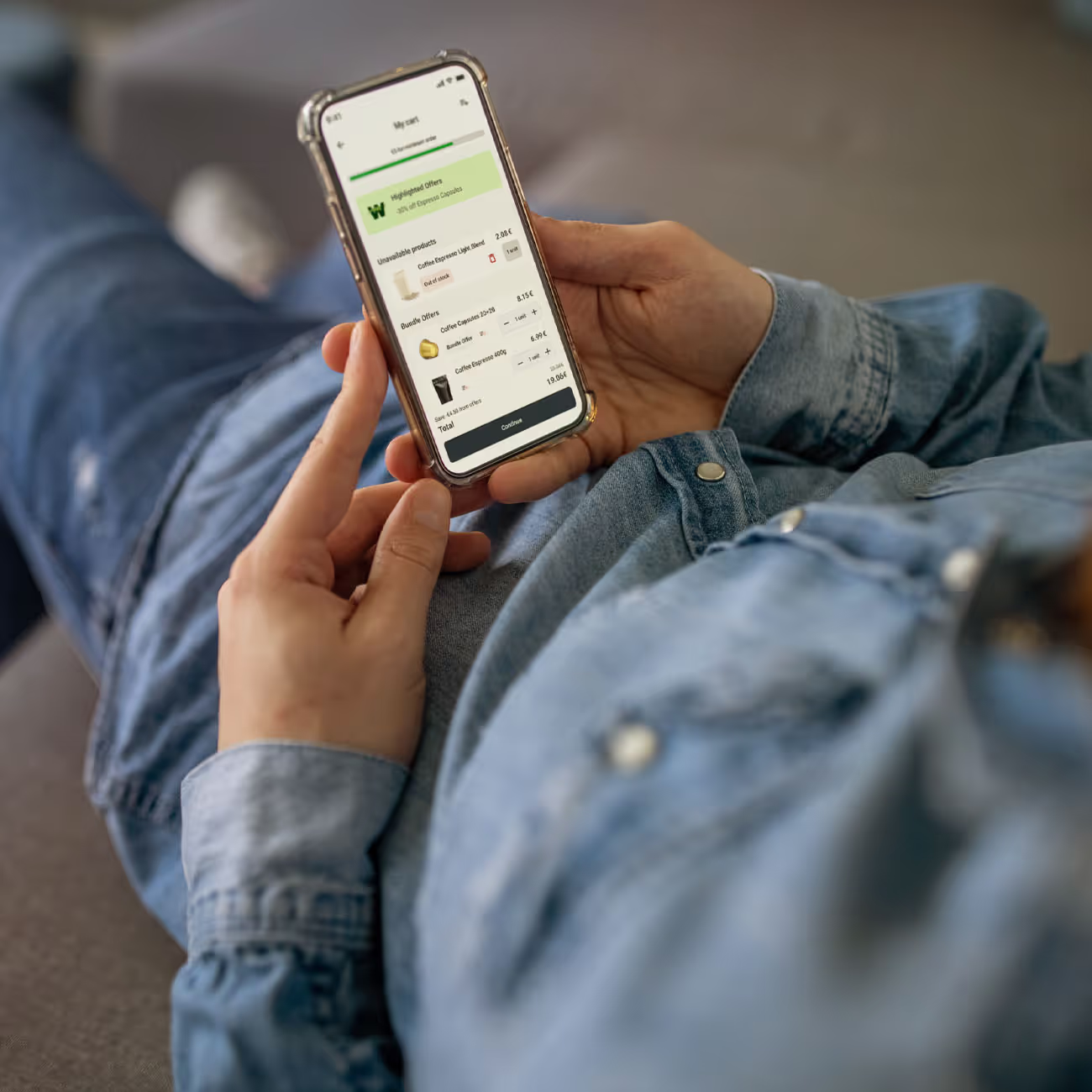
- Substitutions and out-of-stock logic that keep the order moving and customer satisfaction high, rather than canceling or creating friction.
- Order editing post-purchase. Customers inevitably forget something. They can update their order after submission without starting over.
- Fulfillment built for grocery reality. Pickup and delivery scheduling with configurable zones, time slots, and capacity limits per store. A picker app that runs on standard smartphones (no specialized hardware), enabling rapid rollout to new locations. Micro-fulfillment support so retailers can serve online orders from dedicated centers alongside their store network.
Retention and loyalty are built into the product from day one, not bolted on. Wave CXM, our in-house loyalty engine, powers the full retention stack:
- Points, coupons, cashback, and gamification (scratch cards, wheel of fortune, referral programs)
- Behavior-driven push notifications, not spam
- Segmentation, campaign tooling, and a personalization engine for the marketing team
- Upsell and cross-sell options that don't disrupt the shopping flow
- Mobile-specific loyalty features: barcode scanning, add loyalty card to Google Pay / Apple Wallet
Design: Making the 55-Item Cart Feel Effortless
"Most e-commerce platforms are designed for baskets of one to five items. Our users manage 55 products per order. That changes everything. Every design decision, from custom lists to smart reorders to AI-powered recommendations, is built around one goal: speed-to-basket. In grocery, if the UX makes a large shop difficult, you don't just lose a sale. You lose that customer for an entire month."
Every design decision reflects the reality of large, habitual grocery baskets:
- Custom lists, smart reorders, and favorites. Managing dozens of product decisions per order would be exhausting without shortcuts.
- AI-driven personalization ("For You" products). Algorithms that don't just recommend, but actively accelerate the shopping process.
- AI-powered search with typo tolerance and local-language support (including transliteration for non-Latin scripts), so customers find what they need without exact spelling.
- Conversion-safe checkout. In grocery, a failed checkout doesn't mean a lost impulse buy. It means losing a €120–€200 weekly basket and potentially disrupting a customer's routine for the entire week. For grocery, where baskets are large and purchases are habitual, the stakes are higher than in any other e-commerce vertical.
The checkout flow is engineered with a zero-tolerance approach to friction:
- Short, simple flows with minimum steps from "add to cart" to completed order
- Multiple payment options with hardened loyalty card flows, retry logic, and clear failure states
- Fast cart and payment processing, even under peak traffic and large baskets (40–80 items)
Design also powers the multi-partner experience. Each partner's app reflects their brand, not just in colors, but in structure:
- Key UI components are configurable in structure, not just colors, from product tiles to home screen composition
- In-app wording adapts to each partner's brand voice (formal vs. informal tone)
- Full multi-language support, including RTL (right-to-left) for Arabic
Engineering: One Platform, Many Partners
"The hardest technical challenge wasn't any single feature. It was turning our mobile apps into a true partner-ready platform: one shared codebase that powers multiple partners, each with their own integrations, branding, and language, without building a new app from scratch every time. Today, a full partner setup takes under five minutes. That's what makes this scalable."
Scalability is the engineering story. We turned Wave Grocery into a platform where a full partner "skin + configuration" can be integrated in under 5 minutes (down from ~1 hour):
- Third-party integrations (Google/Apple/Facebook login, analytics, live chat, payment providers) are enabled on demand per partner, keeping each app lean and compliant
- Automated branding and partner setup with minimal manual work
- A B2B version built into the same platform with separate pricing, catalogs, and ordering flows for professional clients (restaurants, caterers, offices), without requiring a separate app or codebase
Integrations handled centrally. ERP, POS, loyalty, and payment integrations are built into the backend and serve both web and mobile simultaneously. Connectors for systems like Odoo, Lightspeed and Sedona support real-time, bi-directional data flow: store-level inventory, pricing, and product updates sync continuously, while online orders flow back into operational systems without manual intervention.
The integration layer includes fault tolerance and automated retry logic, so a temporary slowdown in a partner's ERP doesn't cascade into customer-facing failures. Monitoring tools track integration health in real time across all 700+ stores.
Infrastructure and reliability. Our backend services are deployed to high-reliability AWS regions using Heroku, ensuring 99.999% uptime. The architecture is cloud-native and horizontally scalable: auto-scaling services handle sharp traffic spikes during weekends, paydays, and promotional periods without degrading performance. Graceful degradation patterns ensure that if any external dependency slows down, the customer experience continues using the last known good state rather than failing.
Live monitoring tools notify our team instantly if performance degradation occurs. Daily automated performance monitoring tracks key metrics, including app start time and screen load speed for critical flows like product catalogs and checkout, driving continuous improvement over time.
Our Rollout Process: Phased, Measured, Proven
Every partner launch follows our proven phased rollout methodology, designed to ensure top-quality deliverability:
- Phase 1: App released to ~20% of customers
- Phase 2: Expanded to ~50% after monitoring for issues
- Phase 3: Full rollout to all customers
This disciplined approach lets us catch and resolve any issues before broad exposure. Across all partner launches, rollouts have proceeded smoothly.
Customer onboarding is driven through digital campaigns combined with "download app" incentives: coupons and bonus loyalty points that reward early adopters and build initial momentum.
The Results
Aggregate results across partner-branded apps
Wave Grocery is not a marketplace. Each partner operates their own branded app on our platform, and the figures below are the combined results of those partner apps; not shared marketplace traffic or sales.
Adoption and business outcomes
Our first partner mobile app launched in Greece in [2018, making it one of the earliest dedicated grocery apps in the market. Adoption followed a consistent pattern across partners:
- Early traction within the first quarter of each launch, driven by digital campaigns and in-app incentives (coupons and bonus loyalty points for early adopters)
- Steady growth tied to promotion intensity. Partners who actively promoted the app through in-store QR campaigns and email saw the fastest adoption curves.
- Kritikos, our first major partner with 400+ stores, used the app to establish a direct digital channel at a time when virtually no competitor in Greece had a functioning mobile ordering experience.
- One partner set an initial adoption target of 30%+. The app stabilized at ~20% of total customers, a strong result given that not all customer segments are digitally native. At Thanopoulos, mobile now accounts for 20% of total online orders, with app ratings of 4.8 (Google Play) and 4.7 (App Store).
- When COVID-19 hit in 2020, our partners with mobile apps already in place were fully prepared for the surge in online grocery demand, while competitors scrambled to build from zero. Our team received a crisis management award for the response during the pandemic.
- Post-pandemic, mobile adoption continued to grow as customers who had tried online grocery during lockdown remained active users.
Continuous evolution
The platform didn't stop at launch. Each major iteration was driven by real operational feedback and evolving customer behavior:
AI-powered personalization. As order history data grew, we deployed machine-learning-powered "For You" product recommendations and AI-powered search with typo tolerance and local-language support. For customers managing large weekly shops, this significantly reduced the time from opening the app to completing a basket.
B2B expansion. Several partners needed to serve professional clients (restaurants, caterers, offices) alongside consumers. We built a full B2B version into the same platform with separate pricing, catalogs, and ordering flows, without requiring a separate app or codebase.
Continuous performance optimization. Daily automated monitoring now tracks app start time and screen load speed for critical flows, ensuring that performance improves over time rather than degrading as features are added.
Why It Worked: The Desquared Difference
At Desquared, we have been building and operating digital products since 2012 for top-tier enterprises across telecom, banking, and retail, including Cosmote Telekom, National Bank of Greece, Alpha Bank, Heron, Public, and BOX.
Wave Grocery is the productized outcome of our expertise: a platform purpose-built for grocery e-commerce, not a generic solution retrofitted for the industry.
The difference shows in the details:
- A UX designed for large grocery carts, not 5-item baskets
- Infrastructure built for 99.999% uptime with automated scaling
- A multi-partner architecture that onboards new retailers in minutes, not months
- +45% average yearly conversion growth across the Desquared portfolio
- A track record of 4.7 average store ratings and steady adoption growth across every partner
| Metric | Figure |
|---|---|
| Monthly sales generated through partners' own branded apps (combined) | <b>€2,500,000+</b> |
| Monthly transactions across partner apps (combined) | <b>50,000+</b> |
| Partner stores served by the platform | <b>700+</b> |
| Monthly loyalty transactions powered by Wave CXM across partner apps | <b>1,800,000+</b> |
| Monthly customers served across partner apps (combined) | <b>350,000</b> |
| App Store / Play Store rating (average)* | <b>4.8+ / 5</b> ⭐️ |
| Average yearly conversion growth (Desquared portfolio-wide)** | <b>+45%</b> |
| People served monthly (all Desquared products) | <b>6,000,000+</b> |
*App Store / Play Store rating note: “4.8+ / 5” reflects a consolidated average across Wave Grocery partner-branded apps, based on store ratings observed on both iOS (App Store) and Android (Google Play). Individual partner apps, time windows, and store locales can vary, so some sources may show slightly different point-in-time averages.
**The +45% average yearly conversion growth is a portfolio-wide figure across all Desquared products, not specific to Wave Grocery alone.