Most order picking accuracy problems in grocery fulfillment don’t start with technology. They come from rushed picking during peak hours, fragmented inventory data, and stores trying to run e-commerce with workflows designed for walk-in shoppers.
Grocery and beverage sales rose 0.59% month over month and 4.08% year over year, figures that seem small but meaningfully increase pressure on order picking, stock accuracy, and labour allocation as online demand grows alongside traditional foot traffic.
Small gaps can always turn into mis-picks, complaints, and higher labour costs. Improving accuracy is less about speed and more about removing the daily conditions that create errors in the first place.
What does order accuracy mean?
In grocery ecommerce, order accuracy simply reflects how often a customer receives exactly what they asked for; nothing missing, nothing substituted incorrectly, nothing in the wrong quantity or size.
A yoghurt swapped for the wrong flavour, a pack of tomatoes past their date, or a missing loaf of bread all count as picking errors that make an order inaccurate.
Most grocers discover that order accuracy breaks long before delivery. It usually breaks at the shelf. When stock information is outdated, labels are inconsistent, or pickers are rushed during peak hours, the odds of mis-picks rise.
Even well-trained staff struggle when the store layout forces them to revisit the same aisle several times or when two products share almost identical packaging.
Each inaccurate order triggers extra labour (repicks, refunds, customer communication), increases waste, and - when repeated - pushes loyal customers toward competitors. When margins are already tight, these small picking errors often decide whether an order remains profitable or not.
Ultimately, order accuracy describes how reliably a retailer can fulfill orders without forcing the customer or the business to absorb the consequences of avoidable mistakes.
It is a daily operational test of inventory discipline, of picking processes, and of how well a store can manage online volume without losing control.
How do you measure order accuracy?
Retailers typically measure picking order accuracy by comparing how many orders were fulfilled without a single mistake against the total orders shipped. The calculation is straightforward:
Order accuracy rate = (Perfect orders ÷ Total orders) × 100
A “perfect order” means every line, quantity, and substitution is correct. Some operators track the inverse instead (incorrect orders) to spot where picking errors or stock issues consistently occur.
What is a good order accuracy rate?
If ten orders leave the store and one arrives with a wrong item, the order accuracy rate is 90%. Most organized grocery operations target 98%+, because anything lower tends to generate avoidable labour costs and erode customers’ trust.
Operational weak points that reduce order accuracy
Most order accuracy issues in grocery fulfillment come from everyday operational pressures rather than dramatic failures. When volume rises, small weaknesses in process, layout, or communication quickly turn into picking errors.
Understanding where accuracy breaks helps you decide how to reduce manual picking errors before they affect labour costs, refunds, and customer trust.
Common obstacles that reduce order picking accuracy include:
1. Rushed manual picking during peak hours
When pickers rely on memory, shelf labels, or handwritten lists, mistakes are almost guaranteed, especially in high-density categories like yoghurt, snacks, or breakfast cereals.
Fatigue and time pressure are the biggest contributors to order inaccuracies. Once a picker misreads a size or grabs the wrong variant, the error typically goes unnoticed until delivery.
2. Similar-looking products and complex assortments
Grocery assortments create frequent mis-picks: different milk fat percentages in identical cartons, multipacks that differ by one unit, or seasonal packaging that confuses even experienced staff.
Without clear product cues and stable stock locations, order accuracy drops as order volume grows.
3. Inconsistent communication between store teams
If shelf stockers, pickers, and customer service teams operate with slightly different information, substitutions become guesswork. This is one of the most common causes of customer complaints and refund requests.
Operators often underestimate how much clarity is lost during shift changes or ad-hoc handovers.
4. Fragmented systems and delayed stock updates
When inventory, online orders, and store operations run on separate systems, pickers receive instructions that don’t match shelf reality. This leads to avoidable picking errors and last-minute substitutions.
Retailers facing this problem often think they need to train their pickers better, but the root cause is usually data lag, not picker performance.
Any retailer running in-store fulfillment will face the same structural pressures as their business grows, unless the underlying processes are redesigned with the right processes and tools.
How to improve picking accuracy as volume grows
Improving order accuracy in grocery fulfillment requires fixing the operational conditions that create picking errors in the first place.
Most issues are not caused by poor fulfillment or staff performance, but by store layouts, inventory gaps, unpredictable workloads, and unclear rules.
Wave Grocery helps grocery operators address these gaps by aligning picking logic, substitutions, and stock visibility, while applying the practical approaches below to reduce picking errors and maintain consistent accuracy as online volume grows.
1. Reduce walking and decision fatigue
The longer a picker walks, the more decisions they have to make, and the higher the probability of errors. In a typical supermarket route (produce → dairy → bakery), pickers often revisit aisles because online orders rarely follow shelf logic.
Each repetition increases the chance of mis-picks, especially in categories with multiple similar SKUs.
Reducing walking distance is one of the most effective ways to improve order picking workflows.
Grouping high-frequency lines together, simplifying routes, or using pre-defined picking paths cuts decision fatigue, which is a major cause of inaccurate orders.
2. Standardize substitutions
Unstructured substitution rules like “pick something similar” almost guarantee inconsistency. When two pickers interpret “similar” differently, customers end up with unexpected products, leading to refunds and avoidable customer-service workload.
Retailers that predefine acceptable substitutions for each SKU see fewer complaints. Clear rules reduce the number of decisions a picker must make and directly lower error rates.
3. Provide predictable workloads
Accuracy drops when pickers are rushed by last-hour orders or unpredictable peaks. Under pressure, they skip checks, misread labels, and overlook small differences between variants.
Giving pickers a steady, predictable workload instead of sudden bursts of orders that force rushed, error-prone picking helps stabilize accuracy. Staff work at a sustainable pace, not in bursts of urgency.
4. Improve shelf labelling and storage consistency
Inconsistent shelf labelling sends pickers on guesswork. Clear, colour-coded zones for chilled goods, bakery, household items, and produce minimize hesitation and speed up identification.
Even small improvements, like separating visually similar pack sizes, can significantly reduce order picking errors in high-density departments.
5. Use batch picking only when it helps
Batch picking reduces walking time, but it increases complexity. When the same item is picked for multiple orders simultaneously, mixing batches becomes a real risk, especially where inventory accuracy is unstable.
Batch picking works well for long-life items with predictable stock levels, but it can hurt accuracy for categories with variable freshness or frequent substitutions.
6. Equip pickers with systems that keep errors in check
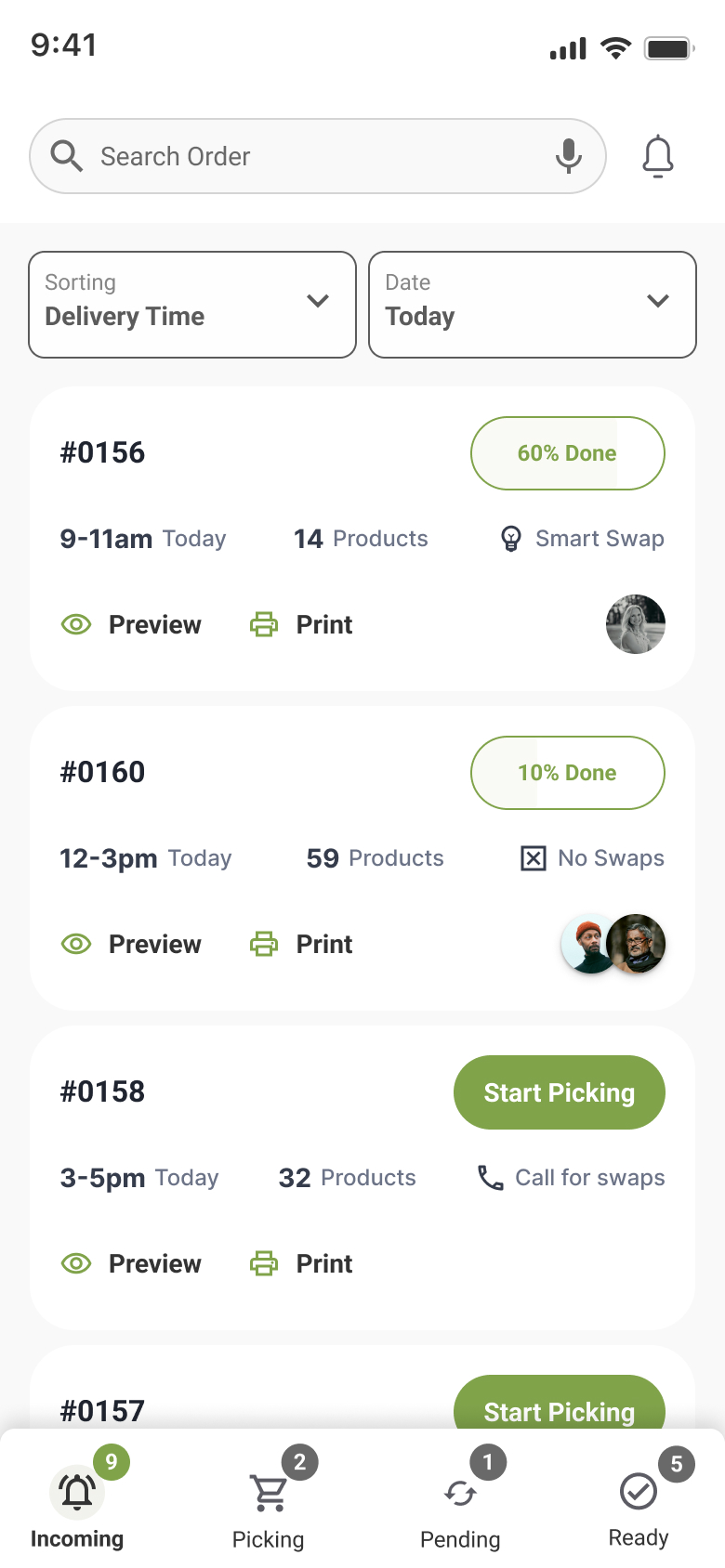
RF barcode scanners are the most common example. A quick scan confirms the correct item immediately, without relying on label reading or memory. This helps operators keep picking errors in check, especially in categories where products look almost identical.
Another option is light-directed picking, used in more structured back-of-store or micro-fulfillment setups. Lights or displays show exactly where the next SKU sits and how many units to take.
They are most effective when the assortment is stable, and items have fixed locations.
7. Use feedback loops to strengthen accuracy over time
Sustained order accuracy comes from continuously reviewing where mistakes occur. Operational data highlights bottlenecks. Customer complaints and returns reveal recurring mis-picks or unclear substitutions.
Frontline staff and suppliers often flag practical issues like confusing layouts, similar packaging, unreliable stock locations, if asked directly. Plus, these problems rarely surface in metrics.
When various feedback sources are combined and reviewed, you gain a clear view of where accuracy breaks and can implement targeted fixes that will reduce future errors.
8. Technology supports more accurate picking
Technology improves order picking accuracy when it reduces ambiguity for pickers. Simple tools such as barcode scanning, directed picking, and reliable stock visibility prevent most day-to-day mistakes.
Accuracy improves further when inventory, orders, and substitutions run through a single logic layer.
Wave Grocery’s picker app helps you keep picking instructions, stock data, and fulfillment rules aligned, so your picking team faces fewer surprises and makes fewer errors.
Picking methods compared: when accuracy rises or falls
Each picking method can perform well or break down depending on volume, layout, and inventory stability.
For example, single-order picking stays accurate at low volume but fails under peak pressure due to fatigue. Batch picking reduces walking time, but accuracy drops quickly when similar SKUs are picked together.
Zone picking works best when handoffs are structured, while centralized picking depends heavily on timely replenishment
The sections below explain where each method breaks in real grocery operations, and how to reduce those risks as volume grows.
Organized operators achieve higher accuracy by keeping picking flows predictable and inventory logic consistent.
Wave Grocery's partners enjoy a 100% order picking accuracy, and up to 30% increase speed, all thanks to our grocery-focused picker app.
The outcome is steadier, more reliable accuracy built on stable processes.
If you want to see how our picker app can help you optimize your picking process, book a 15’ call.
%2520copy.jpeg)
Tasos Koskolos is Head of Product, applying an engineering mindset to e-grocery tools that boost throughput, accuracy, and customer loyalty.

Our editorial team works hand-in-hand with grocery experts and digital specialists to deliver actionable content designed to help your business thrive online. Each article is built on real industry insights and practical guidance for grocers, providing actual solutions to real problems.