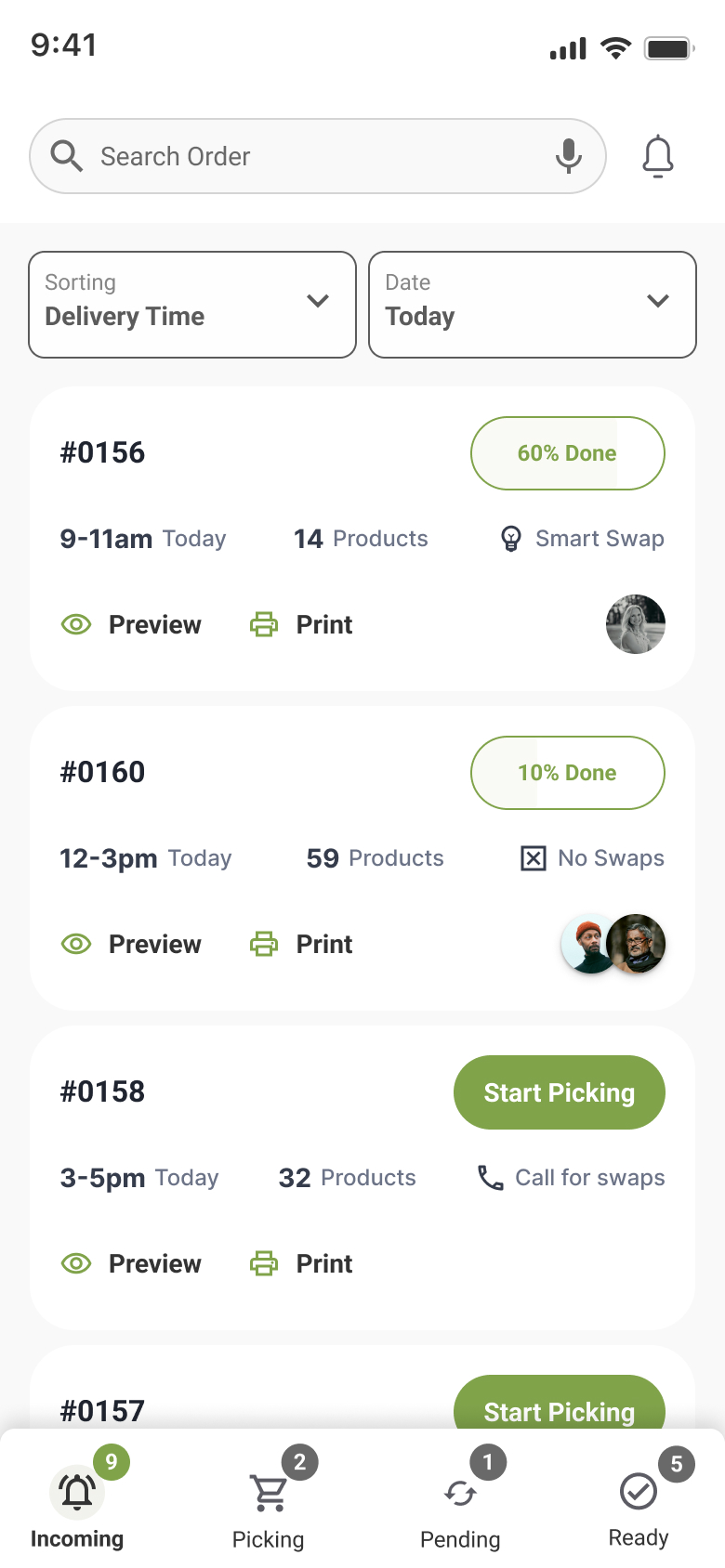
Online grocery is now a meaningful and growing share of total revenue for most chains, and orders fragmented across web, app, phone, and in-store are quietly eating the margin. A purpose-built grocery order management system (OMS) is the layer that fixes that. This guide compares the eight platforms grocers actually shortlist in 2026: what each is built for, where it breaks, and how to evaluate them against the KPIs that matter: pick minutes per order, cost-per-drop, substitution acceptance, and refund rate.
How we picked the list
A grocery OMS isn't a POS, an ERP, or a WMS. It's the orchestration layer that sits on top, coordinating online orders from checkout to delivery across channels and stores. For a primer, see our guide on what an OMS is and how it works.
We evaluated every platform on three things grocery operators actually buy on:
- Grocery-specific depth: weighted items, substitutions, time-slot capacity, multi-store and dark-store routing, perishables. Generic retail OMSes break here.
- Stack fit: how cleanly it integrates with your POS, ERP, payments, and last-mile tools, without forcing a rip-and-replace.
- Operator KPIs: the four numbers a Head of Digital is judged on: pick minutes per order, cost-per-drop, substitution acceptance, and refund rate.
Where vendor claims couldn't be verified from public sources, we said so.
The 8 best grocery order management systems in 2026
1. Wave Grocery, Editor's pick
Best for: mid-to-large grocers who want a grocery-purpose-built OMS, picker app, and delivery orchestration in one modular platform, without ripping out their POS or ERP.
Overview. Wave Grocery is a grocery-specific SaaS platform built by operators who have run online grocery P&Ls. It combines an OMS, picker app, and delivery orchestration layer into a modular stack you can turn on in stages. Unlike retrofitted retail OMS platforms, every feature is designed for grocery's edge cases from day one.
Key features.
- Real-time slot capacity tied to picker throughput and fleet capacity
- Catch-weight and weighted-item handling with authorisation hold → final capture
- Customer-configurable substitution rules and approval flows
- Multi-store and dark-store routing with split-basket logic
- Integrated picker app with voice, scan, and photo confirmation
- Live delivery dispatch with driver tracking and ETA updates
Integrations. SAP, Oracle Retail, Microsoft Dynamics, Stripe, Adyen, Stuart, Urbantz, Bringg, plus open APIs for bespoke POS/ERP combinations.
Pros.
- Purpose-built for grocery from checkout to doorstep
- Modular rollout reduces migration risk: start with OMS, add picker, add delivery
- Proven at scale with Kritikos, +350% coverage expansion, 7× fulfilment capacity, 30% lower ops cost, 4.7/5 customer rating, pick time reduced from 45 to 22 minutes
Cons.
- Not the right fit for a single-store independent grocer
- White-label by design, so it won't hand you a ready-made marketplace shopper base the way Instacart would
Pricing. Custom quote based on store count and transaction volume.
👉 Book a Wave Grocery demo or see how the OMS works.
2. FoodStorm
Best for: grocers with a heavy deli, bakery, or prepared-foods ("perimeter") business.
Overview. FoodStorm, now part of Instacart, focuses on counter and catering orders, cakes, platters, prepared meals. It is widely deployed across US chains to cover the perimeter of the store that most OMS platforms ignore.
Key features. Catering order builder, deposit management, counter-order routing, production scheduling, allergen flags.
Integrations. Instacart storefront, major US POS systems, common payment processors.
Pros. Deep perimeter specialisation; strong production scheduling; strong US reference base.
Cons. Narrow use case, not a full-basket grocery OMS. Tight coupling with Instacart can be a pro or a con depending on your channel strategy.
Pricing. Custom quote.
3. Mercatus
Best for: North American mid-enterprise grocers who want a fulfilment-first stack with their own brand on the front end.
Overview. Mercatus offers digital storefront, order fulfilment, and last-mile tooling aimed at regional US and Canadian chains. Strong white-label positioning against Instacart's marketplace model.
Key features. White-label storefront, picker app, third-party delivery integration, reporting.
Integrations. Common North American POS and ERP systems, DoorDash, Uber, Shipt.
Pros. Clear white-label positioning; strong regional reference base; fulfilment-first architecture.
Cons. Mostly North America; less depth on multi-store routing than purpose-built grocery OMS vendors.
Pricing. Custom quote.
4. Nextuple
Best for: tier-1 enterprise grocers (the largest national chains, typically 200+ stores) with internal engineering teams who want a composable, best-of-breed OMS.
Overview. Nextuple sells a composable order management and inventory platform with grocery-specific modules. Aimed at enterprises who already have engineering capacity and want microservices over a monolith.
Key features. Composable order orchestration, inventory visibility, fulfilment optimisation, store fulfilment app.
Integrations. Manhattan, SAP, Oracle, major commerce platforms.
Pros. Composable architecture suits enterprises replacing legacy OMS piece by piece; strong inventory layer.
Cons. Heavier implementation lift; requires internal engineering maturity; less turnkey than grocery-specific SaaS.
Pricing. Custom quote, enterprise-tier.
5. KBRW
Best for: European enterprise grocers chasing omnichannel maturity with waste-reduction goals.
Overview. KBRW is a French enterprise OMS vendor with a grocery practice that emphasises waste reduction through better inventory and promise management.
Key features. Order orchestration, inventory availability, promise management, returns, store fulfilment.
Integrations. SAP, Oracle, major European POS and payment providers.
Pros. Strong omnichannel pedigree; sustainability angle resonates with European grocers; enterprise-grade.
Cons. Longer implementation timelines; pricing suits enterprise budgets.
Pricing. Custom quote, enterprise-tier.
6. Manhattan Active Omni
Best for: tier-1 global retailers who want a proven generic OMS and are willing to do grocery-specific customisation.
Overview. Manhattan Associates' cloud-native OMS is a market leader in retail. It runs some of the largest omnichannel retailers in the world and has grocery deployments, but it isn't a grocery-first product.
Key features. Order orchestration, available-to-promise, store fulfilment, returns, customer service console.
Integrations. Manhattan's broader WMS and TMS suite, SAP, Oracle, major commerce platforms.
Pros. Enterprise pedigree and scale; excellent omnichannel feature depth; strong global support.
Cons. Grocery edge cases (weighted items, substitutions, slot capacity) require customisation; higher total cost of ownership; implementation measured in quarters.
Pricing. Enterprise, custom quote.
7. Fulfillmenttools
Best for: retailers who want a best-of-breed order-routing and store-fulfilment layer on top of their existing commerce stack.
Overview. Fulfillmenttools, a REWE Group company, is a German SaaS OMS focused on order routing and in-store fulfilment. Used across European retail, including grocery.
Key features. Order routing, in-store picking app, ship-from-store, click-and-collect, returns.
Integrations. SAP, Shopify, commercetools, common European POS and carriers.
Pros. Clean modern architecture; strong routing engine; European compliance baked in.
Cons. Not grocery-first, needs configuration for weighted items and substitutions; narrower reference base outside Europe.
Pricing. Subscription, custom quote.
8. Rosie / ShopHero
Best for: small and independent grocers who want a bundled ecommerce + OMS solution with minimal in-house tech.
Overview. Rosie (alongside similar players like ShopHero, Freshop, and MyCloudGrocer) bundles a storefront, basic OMS, and picker workflow for independent grocers and small regional chains. Often integrated with wholesaler inventory feeds.
Key features. Ecommerce storefront, basic order management, simple picker tool, delivery and click-and-collect, wholesaler SKU feeds.
Integrations. Major US wholesalers (Unified, Associated), common local POS.
Pros. Fast setup; low entry cost; removes the need for an in-house digital team.
Cons. Limited scalability; weaker multi-store routing; thinner enterprise feature set.
Pricing. Starting from a few hundred USD/month per store.
At-a-glance comparison
Ready to see a grocery-purpose-built OMS in action? Book a Wave Grocery demo and we'll walk you through the OMS, picker app, and delivery layer in one session.

Costas D. Aniston is Customer Success Manager, helping grocery retailers streamline operations, improve fulfillment accuracy, and achieve sustainable growth.

Our editorial team works hand-in-hand with grocery experts and digital specialists to deliver actionable content designed to help your business thrive online. Each article is built on real industry insights and practical guidance for grocers, providing actual solutions to real problems.